Chapter 11

“No boy of mine will be a thief,” ” better to starve than steal.”

This sounds like something I would say to my own child if I was trying to correct him. But it means more then just to say it, After reading this book and seeing the reasons why the boy has to steal it makes me wonder. Stealing is wrong no matter what. But, to steal food as a child who is starving who runs by a vender and takes a fruit from the market place or fending for himself. I have never experience famine on our island. When I was a kid, my parents fell into hard times. we would go fishing and we eat off the fat of the land. My mom says we would return to the land (aina) for survival. We picked guava, mango and coconut so freely, we had sweet potato leaves and boiled fish soup. What would also be super beneficial because we had the check on the first of the month, EBT that helped. But the children and the people in North Korea according to this book didn’t have that, they just starve to death. We should plant fruits and vegetables for the families in North Korea. Anyone interested?

Without a Paycheck

Without A Paycheck

North Korean leaders pose the greatest threat to its working class to pursue economic freedom. North Koreans cannot pursue economic freedom like us Americans, because it is considered an economic crime. Although they can have a job, at any given time their paycheck can be cut. In the book, Dr. Kim’s salary disappeared. When Dr. Kim got no pay, she could not feed her child and her family started falling apart. In North Korea, it is illegal to make private money. An example of this is when Dr. Kim’s patient got arrested for earning money through private business, (Demick 108).

Nature

Feb 5, 2019

Page 84

Can’t help to notice the descriptions of landscaping of North Korea and the beautiful healing natural of the country.

“The road crossed over a small stream with sandy banks and turned sharply to the left, where it open up onto the Onpho hot springs resort, known as the only place on Korea where the alkaline Water gushed out from the sand, and a temperatures of 130 degrees ( Fahrenheit) they were reputed to cure ills from indigestion to infertility.  

Think About It!


Think About It! Chapter 1 Page 12

The title, “Nothing to Envy,” are the words of North Koreans, it is the children’s songs, it the message from their leaders, it is on their billboards, and it is a message coming from their own language, culture, and identity. Barbara Demick took this “link” of connection from the North Korean culture and continue to make profit off of it. This is why Demick is a threat to their culture. Not only did she take these words, but she also cut the message short. The North Korean message is suppose to be, “ We have nothing to envy in this world.” This makes the meaning of this message different to their own culture and their daily lives. This situation is similar to the Hawaiian culture. As the Hawaiian Motto, “Ua Mau Ke Ea ‘O Ka ‘Aina I Ka Pono,” which means, “The Life of the Land is Perpetuated in Righteousness.”  These are the words of our own culture and leaders, our keiki’s songs, and is written upon our land. These words are sealed in our hearts and it is already established. Barbra is the threat to their culture this is the economic crime . I am excepting that a royalties of the profit is given back to the North Korean hospital to have food and antibiotics to feed and treat their patients.

Dr. Kim Ji-eun

Feb 4, 2019

Chapter 7: Two Beer Bottles For Your IV

Doctor Kim’s actions illustrate a Modern Women in the mid 1990s. She was educated, part of the Workers party, and Highly decorated from a young age. Although her parents did not birth a son she held the responsibility of one because she was selected to be a doctor out of her education field position. This could be why she prides herself in values like equality and justice, which is why she would advocate for incarcerated men and children that were receiving poor medical attention.  Although in the end she still suffered the same faith as the multitude of North Korean citizens, starvation, pay cuts or no pay for her labor, poverty, and hardship in family life.

(This is a photo of a women I image Dr Kim looks like)

North vs. South

January 23,2019 : After reading the article, “Hardly Known, Not Yet Forgotten, South Korean POW’s Tell Their Story,” it appears that during war in the 1950s the South was worse off than the North. The South gave back 76,000 POW’s while the North only gave back 8,000 POW’s. The North kept 72,000 POW from South Korea and denied their existence.

In the book, “Nothing to Envy,” it portrays that in today’s era the North seems like a horrible place. But, when you look back at history, Southern people have ran to the North. Stated in the article, “Former POW’s who managed to escape back to South Korea said they were simply not informed that a prisoner exchange was taking place, or even that the war was over,” (Radio Free Asia 1). This shows how they did not know what was going on with their people and country.

Barabara Demick went to North Korea interviewed many people there and came back with a story. As an author, she only got bits and pieces which makes me question her writing and the information she states. I would rather hear a story from actual North Koreans than an American. She also states, “..their country has betrayed them,” this is very astonishing because the North Koreans do not speak this way about their people nor their culture. I would also want to know how she met these individuals she interviewed. What lengths did she take and how did she come up with the interviews she took? What makes her interviews and stories so valuable? How many other journalists have similar stories as her? I believe she is taking World History and is mimicking and infusing it into this story. Could I be right? Looking forward to read more!

Kapu & The ‘Imu

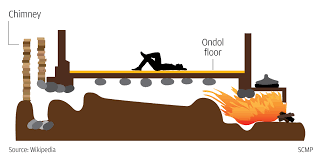
In Chapter one, I am seeing a cultural perspective through North Koreans and the Hawaiian culture. The North Korean and Hawaiian culture had similarities. These similarities included the Kapu system, and an ondol system. The North Koreans segregated their men and women from eating together just like Hawaiians. This was considered the Kapu system. The North Korean women were only aloud to eat cornmeal, while men ate rice. Hawaiian women could not eat bananas, pork, red fish, and coconut. We also learn about the ondol system in the text. The ondol system seems similar to the ‘imu in Hawaiian culture. The ‘imu is an underground oven used to cook food, while the ondol was underfloor heating through wood smoke. It was also used to cook.

Image result for kapu

The Dark Tirades

What is noticeable in the reading is that the author describes North Korea through interviews and her own negative point of view. I also noticed that the North Koreans were more conservative with their lifestyle. I feel that the North Koreans were sheltered within their culture and their relationships. In the text, the teenage interviewee Mi-Ran mentions how she did not know how babies were conceived.

I also notice the main differences between North and South Korea. Back in the 90s North Korea was sitting in total darkness while their “Pro-American Cousins”(Demick) in South Korea were living with electricity. This may have created a bitterness between the North Koreans and Americans. The benefit of not having electricity was that they could share their secret love affairs . For example, just like our Hawaiian caste systems it is similar to those of the North Korean culture.

Throughout the story I feel that the leaders of North Korea, Kim Il-Sung and Kim Jong-Il wants to put an end to carbon dioxide and pollution. To preserve his people after the war they went through, I believe he wants to make the best of what they have through natural resources.

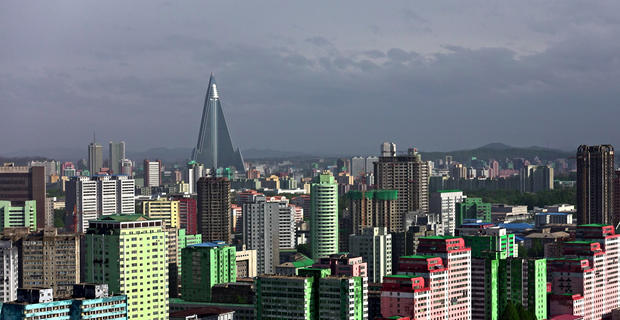
The famous 105-story Ryugyong Hotel ÒPyramid BuildingÓ in Pyongyang. ItÕs massive and has a shiny spaceship-like exterior, but itÕs also uninhabited.